

Cell—penetrating peptides (CPPs) are short oligopeptide chains, consisting of 8-30 amino acids, that can cross the plasma membrane into living cells. These chains, also known as protein transduction domains (PTDs), are being studied extensively for their ability to transport numerous biomolecules, including proteins, nucleic acids, and other substances, into cells, thereby overcoming barriers. Based on their physicochemical properties, CPPs are divided into three groups: cationic, amphipathic, and anionic, which differ in their characteristics and mechanisms of cell entry.
1. Categories and Characteristics of CPPs
Cationic (Positively Charged) CPPs
Cationic CPPs carry a positive charge due to lysine and arginine residues. This property allows interaction with negatively charged components of the cell membrane, facilitating their entry by endocytosis or direct translocation. Their efficacy depends more on overall charge density than on the exact sequence. However, increasing the charge can improve cell entry and increase cytotoxicity.
Amphipathic CPPs
Amphipathic CPPs contain both positively charged and hydrophobic moieties. The positive part binds to the membrane, while the hydrophobic part interacts with the lipid bilayer, facilitating cell entry. Their efficacy depends on the precise arrangement of these regions, which must be carefully optimized to achieve high efficacy with minimal toxicity.
Anionic (Negatively Charged) CPPs
Anionic CPPs contain acidic amino acids that confer a neutral or negative charge. Although one would expect to be repelled by the negatively charged cell membrane, some of these peptides successfully enter cells. However, their mechanisms of entry are not fully understood.
2. Unlocking Therapeutic Potential: Key Applications of CPPs
Cell-penetrating peptides (CPPs) have great therapeutic potential due to their ability to pass through biological membranes. Their crucial application is in drug delivery, where they act as carriers for the transfer of biological molecules across barriers (e.g., the blood-brain barrier and cell membranes). This is significant in tumor therapy, where intracellular delivery of therapeutic agents is necessary.
In addition, CPPs can improve the drug’s bioavailability. It has been shown that they can increase the buccal absorption of macromolecules and improve the oral bioavailability of poorly permeable compounds, enabling the application of peptide and protein therapies.
It is interesting that some CPPs act not only as carriers, but also as active substances with important biological effects. Their dual role enables simpler therapy design while improving efficiency.
3. From Promise to Reality: Addressing Challenges and Solutions
Limited Half-Life, Stability, and Biodistribution:
CPPs have a short half-life and are unstable due to rapid proteolytic degradation, renal clearance, and nonspecific distribution (especially in the kidneys and lungs). These factors significantly limit their daily use, as reflected in the absence of therapies.
The main methods for achieving stability include:
- Terminal modifications (N-acetylation, C-amidation) due to protection against exopeptidases
- D-amino acid substitutions to increase resistance to proteases
- Introduction of non-natural groups in the peptide structure or greater metabolic stability
- Conformational rigidification to reduce degradation
- Stapling-stitching techniques to stabilize the structure
Lack of Target Selectivity:
CPPs are largely non-selective for diseased tissues, which can lead to off-target effects and potential toxicity.
Methods to improve specificity:
- Conjugation with target ligands (molecules, peptides, antibodies)
- Cationic tumor-homing CPPs (eg MT23, BR2) with affinity for tumor membranes
- RGD motifs for integrin targeting
- Antibody-CPP conjugates or more precise delivery
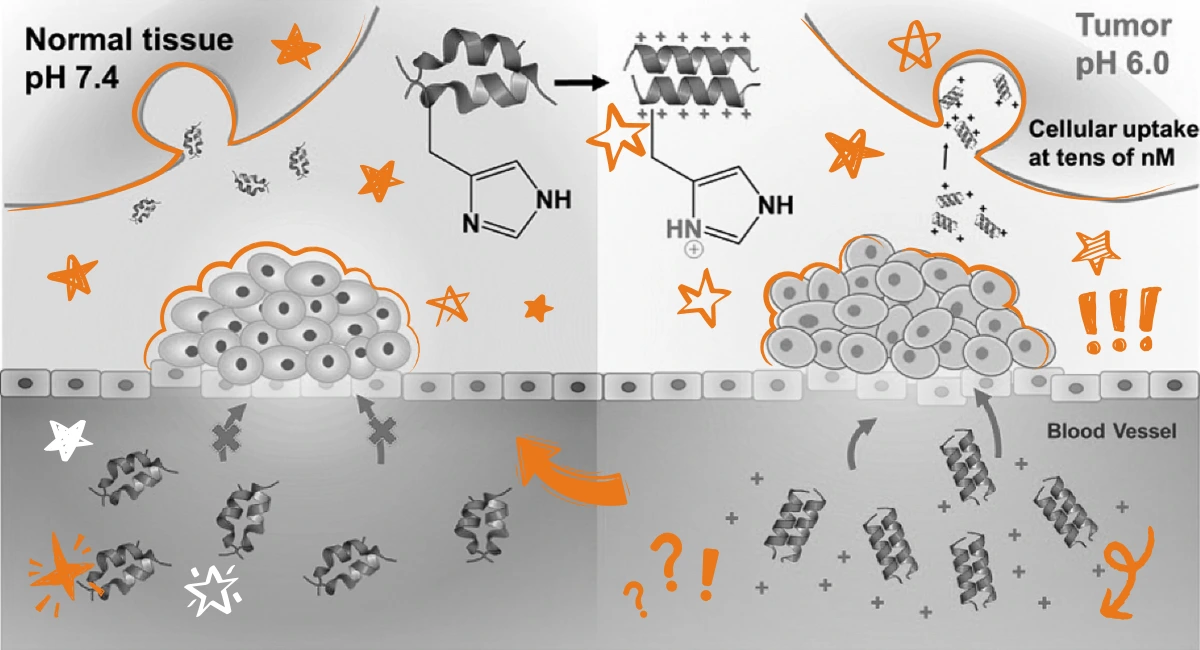
- “Smart” CPPs activated by specific pathological signals
Limited Potency at Physiological Concentrations:
The effectiveness of CPPs is often achieved only at high concentrations, which limits their application.
Improvement strategies:
- Tandem duplication of sequences that enhances penetration at lower doses
- Improvements of endosomal exit, crucial for functionality
- Histidine (His) – the “proton sponge” effect enables release from endosomes.
- Fusogenic peptides for better membrane passage
- Conjugation with fatty acids for increased intake and efficiency
CPPs exhibit antimicrobial, antiviral, and antitumor properties, as well as significant research potential. GenScript provides high-purity CPPs and related peptides for experimental applications.