

Neoantigens-tumor-specific peptides created as a result of somatic mutations are a key element of cancer immunotherapy adapted to patients, since they are not presented in healthy tissues, which reduces the risk of unwanted autoimmune effects and avoids the influence of central tolerance.
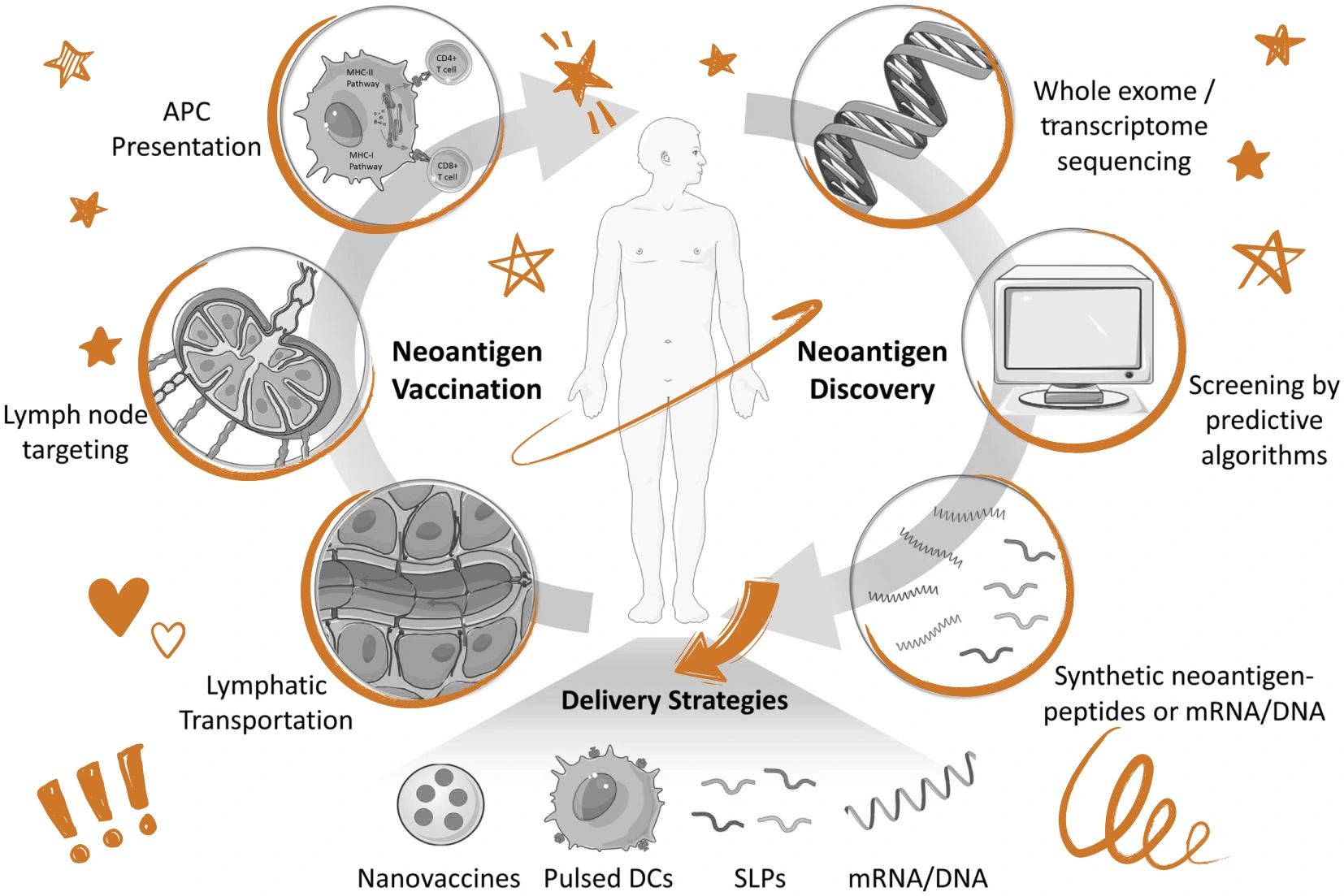
However, their clinical application remains limited due to low immunogenicity, inefficient transport to lymph nodes (LN), and insufficient antigen-presenting cells (APC), especially dendritic cells (DC). To overcome these limitations, delivery platforms have been developed that use biophysical and immunological strategies to enhance vaccine responses.
Nanoparticles (NPs)-Based Vaccines
Mechanism and Advantages
The mechanisms and benefits of nanoparticle vaccines are reflected in the simultaneous and targeted delivery of tumor antigens and immunostimulatory adjuvants to antigen-presenting cells, especially dendritic cells. A key step in this process is the efficient intracellular delivery of antigens to the cytosol, where they are processed and presented via the MHC-I pathway, which enables the activation of a strong cytotoxic T-cell response.
Accordingly, the design of an effective nanovaccine requires the development of carriers that not only enable the transport of antigens to APCs but also contribute to immune stimulation.
As part of cancer immunotherapy, vaccines based on nanoparticles are distinguished by the following advantages:
- Optimized biodistribution: Targeted accumulation in secondary lymphoid organs, such as lymph nodes, with more efficient overcoming of biological barriers.
- Controlled co-delivery: Precise and customizable encapsulation of antigens and adjuvants for an enhanced and synergistic immune response.
- Modulated intracellular processing: Increased cytosolic delivery efficiency, controlled antigen release, and improved cross-presentation in APCs.

Challenges and Future Directions
Despite the therapeutic potential, the application of nanoparticles (NPs) is limited by a number of problems, including insufficient biocompatibility, marked heterogeneity of the system, and uneven production processes, which make their standardization and application difficult.
Additionally, fine-turning the size, surface charge, chemical characteristics, and particles critical for efficient transport to lymph nodes and adequate immune activation remains a research challenge.
On the other hand, protein nanostructures of the “cage” type, such as virus-like particles (VLPs) and ferritin proteins, stand out as promising delivery platforms, thanks to their high biodegradability, precisely organized structure, and simple preparation.
Liposomes
Features and Benefits
- Compared to free neoantigens: Liposomes provide protection of antigens from degradation, enhance their internalization in dendritic cells (DC), and enable delivery of adjuvants.
- Compared to viral vectors: They are characterized by a safety profile, lower inherent immunogenicity, and simpler production.
- Compared to dendritic cell-based vaccines: They do not require ex vivo processing, thus simplifying the overall therapeutic approach.
Challenges and Future Directions
Although liposomes significantly contribute to more efficient targeting and increase cellular uptake, identifying a formulation for neoantigen delivery remains a complex task. An additional factor is the tumor’s ability to evade the immune response, due to antigenic variability or reduced expression of target antigens, which affects the success of vaccination.
To overcome these obstacles, multivalent liposomal systems are being developed that enable the simultaneous delivery of a larger number of neantigens (10-20), thus expanding the spectrum of the T-cell response and reducing the probability of immune evasion.
In addition, stimuli-responsive liposomes are of increasing importance, which enable the spatially and temporally controlled release of antigens in specific microenvironments, such as endosomes or tumor tissues, thus improving the efficiency of the immune response.
Viral Vectors
Mechanisms and Benefits
Viral vectors are genetically modified viruses with pathogenic functions removed, but their ability to efficiently introduce genetic material into host cells is preserved. In the context of neoantigen-based immunotherapy, they are used to directly deliver genes encoding tumor neoantigens to antigen-presenting cells (APCs). This enables intracellular synthesis, processing and presentation via MHC class I and II, which results in coordinated activation of CD8+ cytotoxic and CD4+ helper T-lymphocytes.
Features and Benefits
- Exceptional transduction efficiency: Viral systems are evolutionarily adapted to enter cells, allowing high levels of delivery of genetic material.
- Physiological antigen expression: Intracellular synthesis enables proper protein conformation, adequate post-translational modifications, and efficient antigen presentation.
- Intrinsic immunostimulation: Structural components of the virus act as activators of the immune system.
- Prolonged immune response: antigens contribute to a longer and more stable activation of the immune system.
- Polyvalent capacity: One vector can carry and deliver several different neoantigens simultaneously.
Challenges and Future Directions
The possibility of simultaneous delivery of a large number of neoantigens is essential for overcoming tumor heterogeneity, as it enables targeted action on non-specific tumor subpopulations and reduces the probability of immune “escape”.
However, a crucial challenge in the application of personalized vaccines remains the need for fast, reliable, and timely production of therapies specific to each patient, especially in advanced stages of the disease.
Therefore, future research is focused on simultaneously expanding antigenic coverage and optimizing manufacturing processes to shorten the time from design to application of therapy.
Cooperation in the Development of Neantigen Vaccines
GenScript is developing integrated neoantigen delivery platforms that include a variety of technological approaches- from protein nanostructures and multivalent liposomes to viral vectors-with the goal of effectively translating research into clinical practice. Through collaboration with academic institutions and industry, the focus is on solving challenges, including antigen selection, adjuvant optimization, and establishing scalable, GMP-compliant manufacturing processes.
Their approach integrates all stages of development – from initial discovery, through delivery systems, to further development – providing comprehensive support for next-generation vaccine projects.